
Technology Readiness Levels Explained: How Technology Matures from Concept to Market
In the fast-paced world of innovation, understanding the Technology Readiness Level (TRL) scale is vital for evaluating the maturity of emerging technologies. TRLs are widely used by governments, businesses, and research institutions to gauge how ready a technology is for practical application or market deployment. This article delves into the concept of TRLs, their significance, and an in-depth look at the nine stages of technology development.
What is TRL?
The Technology Readiness Level (TRL) is a framework designed to assess the progress of a technology from its early theoretical concepts to its full-scale, commercial application. Initially developed by NASA in the 1970s, this scale allows organizations, investors, and other stakeholders to measure the maturity of a technology and the risks involved at each development phase. TRLs range from TRL 1 (basic principles observed) to TRL 9 (system proven in an operational environment).
Why Are TRLs Important?
TRLs offer a standardized language that enables clear communication among stakeholders, including project managers, investors, and policymakers. By understanding a technology’s TRL, stakeholders can make more informed decisions about funding, partnerships, and development timelines. The scale also helps ensure that each technology is rigorously tested, optimized, and refined before moving to the next stage, minimizing risk and improving the chances of successful commercialization.
The 9 Stages of TRL
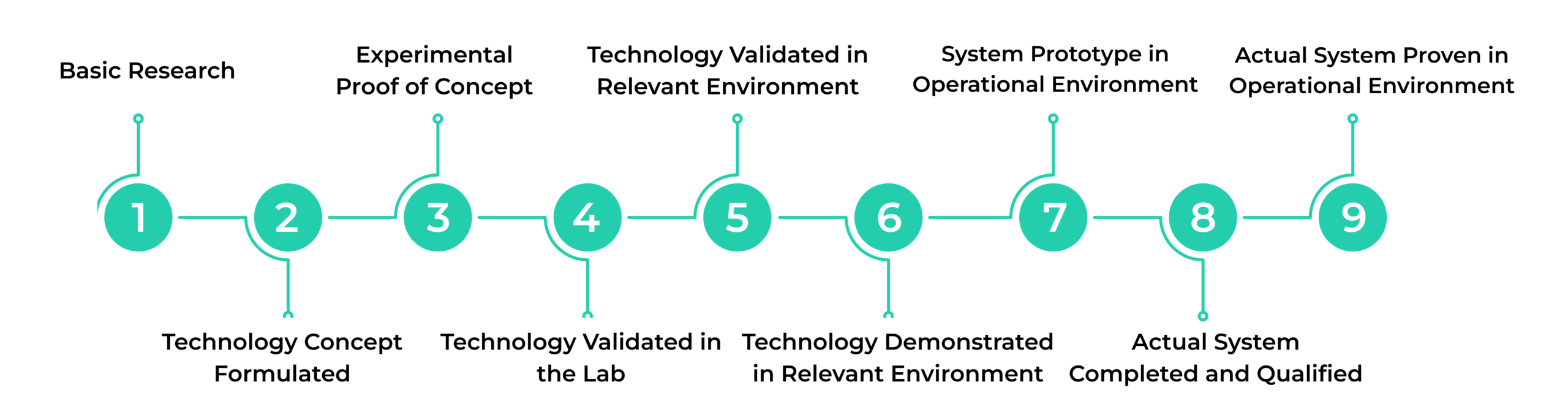
The TRL scale consists of nine stages, each representing a key milestone in the technology development process. Let’s explore these stages in detail:
1. TRL 1: Basic Principles Observed
At TRL 1, the groundwork for new technologies begins. Scientific research identifies fundamental principles, but no practical application has yet been established. This stage is focused on understanding the core concepts that will later drive innovation.
2. TRL 2: Technology Concept Formulated
In this stage, the basic scientific principles identified in TRL 1 are translated into theoretical concepts. Researchers explore whether these concepts could potentially evolve into viable technologies. Feasibility studies are carried out to assess the possibility of developing a working prototype.
TRL 3 marks the transition from theory to experimentation. This stage involves testing the feasibility of the technology through early-stage experiments and prototyping in a controlled environment. The goal is to validate the initial concept and prove that it can work in practice.
4. TRL 4: Technology Validated in Lab Conditions
At TRL 4, the technology undergoes testing in laboratory settings that simulate real-world conditions. Prototypes are further refined, and data is collected to demonstrate how well the technology performs in controlled environments. This stage aims to prove the technology’s viability in practice, though real-world conditions are still not fully replicated.
5. TRL 5: Technology Validated in Relevant Environment
In this phase, the technology is tested in more realistic environments that closely resemble where it will eventually be used. This could include pilot-scale or field testing in conditions that mimic operational scenarios, though it is still a controlled environment. The aim is to understand how the technology will behave in real-world contexts.
6. TRL 6: Technology Demonstrated in Relevant Environment
At TRL 6, the technology undergoes extensive testing and demonstration in environments that closely mirror real-world operations. Performance is assessed under a variety of operational conditions. This stage focuses on refining the prototype to ensure it can meet all requirements before entering full-scale production.
7. TRL 7: System Prototype Demonstrated in Operational Environment
This stage sees the technology as a fully functional prototype that is tested in actual operational environments. The technology is expected to be close to its final design and is assessed for its ability to perform effectively in real-world conditions, often at full scale.
8. TRL 8: Actual System Completed and Qualified Through Test and Demonstration
At TRL 8, the technology is fully developed, tested, and demonstrated in real operational environments. It has been thoroughly validated and optimized for large-scale production. This stage confirms that the technology meets all necessary standards and is ready for commercial deployment.
9. TRL 9: Actual System Proven in Operational Environment
TRL 9 represents the final stage in the development process, where the technology is deployed and proven in real-world environments. At this point, the technology is fully optimized, and its performance meets expectations under normal operating conditions. It is now commercially available and integrated into its intended market.
The TRL scale is a critical tool for evaluating the maturity and risk of a technology throughout its development journey. By understanding the various stages of TRL, stakeholders can make more informed decisions about funding, partnerships, and commercialization strategies. Whether you’re developing a groundbreaking innovation or evaluating an existing technology for market entry, understanding its TRL is key to ensuring its successful deployment and adoption.


ABOUT THE AUTHOR
Andrea Puentes Viana
Marketing Specialist
Andrea is a marketing specialist with a passion for innovation and technology adoption. She focuses on helping businesses effectively communicate their value propositions and reach the right audience through strategic marketing initiatives.
0 Comments